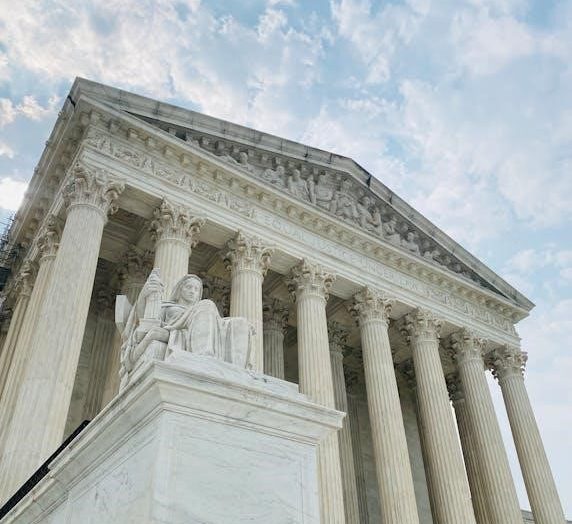
American jurisprudence, reflecting a nation’s civilization, finds its roots in legal systems and historical contexts, notably explored by S.E. Baldwin in 1892.
Historical Significance of Jurisprudence
Jurisprudence, as highlighted since 1892 by Simeon E. Baldwin, serves as a crucial indicator of a nation’s civilization, revealing its societal values and development. The historical reception of English Common Law onto North American soil profoundly shaped the foundation of American legal thought and practice, establishing precedents still referenced today.
Baldwin’s work, “American Jurisprudence,” emphasized the importance of understanding the evolution of legal systems. This historical perspective is vital, as laws aren’t created in a vacuum; they build upon prior rulings, statutes, and constitutional provisions. Examining this lineage provides context for current legal debates and interpretations, offering insights into the enduring principles guiding American law. The study of jurisprudence, therefore, isn’t merely academic; it’s essential for comprehending the present legal landscape.
The Role of Civilization and Legal Systems
Simeon E. Baldwin, in his 1892 work, posited that a nation’s jurisprudence is the “truest gauge of its civilization.” This suggests a direct correlation between the sophistication of a legal system and the overall advancement of a society. Legal systems aren’t simply about rules; they embody a civilization’s moral, ethical, and political philosophies.
These systems provide the framework for resolving disputes, protecting rights, and maintaining social order – all cornerstones of a civilized society. Furthermore, the sources and safeguards of our rights and liberties, as Baldwin noted, are deeply embedded within these legal structures. A robust and just legal system fosters trust, encourages economic growth, and promotes stability, ultimately contributing to a higher quality of life for its citizens. Therefore, jurisprudence isn’t just a part of civilization; it’s fundamental to it.

Sources of American Law
American law originates from diverse sources, including English common law, statutes enacted by governmental branches, constitutional provisions, and judicial decisions.
English Common Law as a Foundation
Historically, American private law’s primary source is the English common law, a system developed over centuries through judicial decisions. This reception of common law onto North American soil formed a crucial bedrock for the nascent American legal system, providing established principles and precedents. Unlike codified civil law systems, common law relies heavily on case law – the accumulated body of rulings from courts.
Early American courts frequently looked to English precedents to resolve disputes, adapting them to the unique circumstances of the colonies and, later, the United States. This wasn’t a wholesale adoption; American courts gradually modified and reshaped the common law to reflect American values and societal changes. The influence of English common law remains significant today, particularly in areas like contract law, torts, and property law, demonstrating its enduring legacy.
Statutes and Legislation
Alongside common law, statutes and legislation constitute a vital source of American law. These are rules enacted by legislative bodies – Congress at the federal level, and state legislatures at the state level. Statutes address a wide range of issues, from criminal law and taxation to environmental regulations and consumer protection. They represent a deliberate and formalized expression of public policy.
The process of creating a statute involves debate, amendment, and ultimately, a vote. Once enacted, statutes have the force of law and are binding on individuals and entities within the jurisdiction. These laws are often codified, meaning they are organized and compiled into comprehensive collections, like the United States Code. Statutes supplement and sometimes modify common law principles, providing a more specific and modern legal framework.
Constitutional Provisions
The United States Constitution, and state constitutions, stand as the supreme law of the land. These foundational documents establish the framework of government, define its powers, and, crucially, guarantee fundamental rights and liberties to citizens. Constitutional provisions take precedence over all other forms of law, including statutes and common law.
Amendments to the Constitution, such as the Bill of Rights, further protect individual freedoms like speech, religion, and due process. The interpretation of constitutional provisions is a central function of the judiciary, particularly the Supreme Court. Judicial review allows courts to invalidate laws that conflict with the Constitution. These provisions are the bedrock of the American legal system, ensuring limited government and protecting individual rights.
Judicial Decisions and Case Law
Judicial decisions, forming the body of case law, represent a vital source of American law. Courts interpret statutes and constitutions, applying legal principles to specific factual scenarios. This process creates precedents – rulings that guide future decisions in similar cases. The principle of stare decisis, meaning “to stand by things decided,” encourages consistency and predictability in the legal system.
Over time, a complex web of case law develops, clarifying and refining legal rules. Higher court decisions bind lower courts within the same jurisdiction. Landmark cases establish significant legal principles, shaping the evolution of American jurisprudence. Understanding case law is essential for legal professionals, as it provides practical application and nuanced interpretation of legal concepts.

Key Legal Texts & Resources
Am. Jur. 2d and C.J.S. are widely recognized legal resources, alongside S.E. Baldwin’s foundational 1892 work, “American Jurisprudence.”
American Jurisprudence 2d (Am. Jur. 2d)
American Jurisprudence 2d (Am. Jur. 2d) stands as a cornerstone of American legal research, a comprehensive encyclopedia offering detailed analyses of various legal topics. This multi-volume set provides a systematic arrangement of legal principles, statutes, and case law, serving as a valuable resource for legal professionals and scholars alike.
It’s designed to assist in understanding complex legal issues, offering summaries of court decisions and interpretations of statutes. Researchers utilize Am. Jur. 2d to gain a broad overview of a legal area, identify relevant case law, and understand the nuances of legal doctrines; Its extensive coverage and detailed explanations make it an indispensable tool for legal analysis and preparation.
The work is continually updated to reflect changes in the law, ensuring its relevance and accuracy. It is considered one of the most widely known and respected legal encyclopedias in the United States, alongside its counterpart, Corpus Juris Secundum (C.J.S.).
Corpus Juris Secundum (C.J.S.)
Corpus Juris Secundum (C.J.S.), alongside American Jurisprudence 2d (Am; Jur. 2d), represents a foundational resource within American legal scholarship and practice. This extensive legal encyclopedia meticulously organizes and presents a vast compilation of legal principles, statutes, and judicial decisions, offering a comprehensive overview of American law.
C.J.S. is renowned for its detailed annotations and thorough analysis of legal concepts, assisting legal professionals in navigating complex legal landscapes. It provides summaries of case law, interpretations of statutes, and discussions of legal doctrines, facilitating efficient legal research and informed decision-making.
Like Am. Jur. 2d, C.J.S. undergoes regular updates to maintain its accuracy and relevance in a constantly evolving legal environment. Both encyclopedias are vital tools for lawyers, judges, and legal scholars seeking a deep understanding of American jurisprudence.
Simeon E. Baldwin’s “American Jurisprudence” (1892)

Simeon E. Baldwin’s seminal work, “American Jurisprudence” (1892), stands as a cornerstone in the historical development of American legal thought. Baldwin posited that a nation’s truest measure of civilization resides within its system of jurisprudence, a concept central to his comprehensive analysis.
This foundational text meticulously examined the sources and safeguards of rights and liberties, laying the groundwork for subsequent legal scholarship. It explored the intricate relationship between law, society, and governance, offering insights into the evolving American legal landscape of the late 19th century.
Baldwin’s work remains a valuable resource for understanding the historical context of American law and its enduring principles, influencing later publications like Am. Jur. 2d and C.J.S.

The American Legal Profession & Debate
During the 1930s, the American legal profession became a significant forum for intense and sustained intellectual debates within the nation’s history.
Intellectual Debates of the 1930s
The 1930s witnessed a period of profound intellectual ferment within the American legal profession, evolving into one of the most bitter and sustained debates in the nation’s history. This era saw vigorous discussions concerning the very foundations of legal thought and practice, challenging established norms and prompting re-evaluations of legal principles.
These debates weren’t confined to academic circles; they permeated the practical application of law, influencing judicial decisions and legislative actions. The core of the contention revolved around differing perspectives on the role of law in society, the nature of legal reasoning, and the appropriate balance between individual liberty and collective welfare.
Scholars and practitioners grappled with questions of legal realism, sociological jurisprudence, and the impact of economic and social forces on the legal system. This period marked a turning point, laying the groundwork for subsequent developments in American legal theory and practice, and continues to resonate within contemporary legal discourse.
The Forum for Legal Discussion
During the 1930s, the American legal profession itself transformed into a central forum for intense intellectual debate. This wasn’t merely a collection of isolated arguments, but a sustained, widespread conversation impacting the entire field. Legal journals, conferences, and law school classrooms became battlegrounds for competing ideologies, fostering a dynamic exchange of ideas.
This period saw a heightened awareness of the social and economic context of law, prompting legal professionals to critically examine the existing legal framework. The debates weren’t simply academic exercises; they had real-world consequences, influencing legal scholarship, judicial opinions, and legislative reforms.
The profession’s willingness to engage in self-criticism and open discussion was crucial in shaping the future direction of American law, fostering a more nuanced and responsive legal system. This era solidified the legal profession’s role as a vital space for intellectual inquiry and societal progress.

Understanding Legal Rights
Legal rights are typically grounded in authoritative sources—statutes, judicial decisions, or constitutional provisions—distinct from moral claims and principles.
Authoritative Sources of Legal Claims
Establishing legal claims fundamentally relies on recognized, authoritative sources within the American legal framework. These sources provide the bedrock for asserting and defending rights, and are crucial for navigating the complexities of the legal system. Primarily, statutes enacted by legislative bodies – at both the federal and state levels – serve as a cornerstone of legal authority.
Furthermore, judicial decisions, often referred to as case law, hold significant weight, interpreting statutes and establishing precedents that guide future rulings. Constitutional provisions, enshrined in the U.S. Constitution and state constitutions, represent the highest form of legal authority, defining fundamental rights and governmental powers.
Legal professionals and individuals alike consult comprehensive legal resources like American Jurisprudence 2d (Am. Jur; 2d) and Corpus Juris Secundum (C.J.S.) to understand these sources and their application, ensuring claims are firmly rooted in established legal principles.
Distinction Between Legal and Moral Rights
While often intertwined, legal and moral rights represent distinct concepts within the American jurisprudence system. Moral rights stem from ethical principles and societal values, representing what should be, based on notions of fairness and justice. They lack the enforceability inherent in legal rights.
Legal rights, conversely, are those codified in statutes, constitutions, and judicial decisions, providing individuals with enforceable claims against others or the government. These rights are backed by the power of the state, allowing for legal recourse if violated. A moral obligation to assist someone differs greatly from a legal duty to do so.
Understanding this distinction is crucial; an action may be morally reprehensible yet legally permissible, or vice versa. Resources like American Jurisprudence aid in discerning the boundaries between these realms, clarifying what is legally protected versus ethically desirable.

Accuracy and Reliability of Legal Information
Legal texts, like American Jurisprudence, are based on sources believed accurate, yet are current only as of their writing, requiring careful consideration.
It is crucial to acknowledge that legal information, even within comprehensive resources like American Jurisprudence 2d (Am. Jur. 2d) and Corpus Juris Secundum (C.J.S.), possesses a temporal dimension. These publications, while meticulously researched and compiled, are inherently bound by the date of their creation and subsequent updates.

The legal landscape is perpetually evolving, shaped by legislative enactments, judicial precedents, and constitutional interpretations. Therefore, information presented in any legal text should not be considered a substitute for current legal counsel or a comprehensive, up-to-date legal search. Reliance on outdated information can lead to inaccurate conclusions and potentially detrimental outcomes.
Users are strongly advised to verify the continued validity of any legal principle or rule cited from these sources with current statutory codes, case law, and professional legal guidance. The publisher disclaims any responsibility for consequences arising from the use of information that is not current.
Sources and Safeguards of Rights & Liberties
Fundamental rights and liberties within the American legal system are deeply rooted in a variety of sources, prominently including statute books, judicial decisions, and constitutional provisions. These sources collectively form the bedrock upon which individual freedoms are protected and enforced.
As highlighted in historical legal texts, like those by S.E. Baldwin, these sources aren’t merely abstract principles; they actively serve as safeguards against governmental overreach and private infringement. The continuous interpretation and application of these legal foundations by the courts ensure their relevance and adaptability to evolving societal norms.
Resources such as American Jurisprudence 2d and Corpus Juris Secundum meticulously document these sources, providing a comprehensive framework for understanding and asserting one’s legal entitlements. Vigilance and informed citizenship are also vital safeguards.

Structure of American Law
American law’s structure arises from laws enacted by diverse governmental branches, alongside jurisdictional variations, creating a complex yet interconnected legal landscape for citizens.
Laws Enacted by Different Branches of Government
The American legal system distinctly separates powers, resulting in lawmaking originating from multiple governmental branches. The legislative branch, encompassing Congress at the federal level and state legislatures, crafts statutes and legislation – formally written laws addressing a wide range of societal issues. These laws establish general principles and rules applicable to all within their jurisdiction.
The executive branch, headed by the President or state governors, contributes through executive orders and regulations, which clarify or implement existing laws. These actions possess the force of law within defined parameters. Finally, the judicial branch, with courts at various levels, interprets laws through judicial decisions and case law, shaping their application and establishing precedents for future cases.
This interplay ensures a system of checks and balances, preventing any single branch from wielding absolute legal authority, and contributing to the dynamic evolution of American law.
Jurisdictional Variations in Law
American law isn’t monolithic; significant variations exist across different jurisdictions – federal, state, and even local levels. Each state possesses its own constitution, statutes, and court systems, leading to diverse legal landscapes. While federal law establishes nationwide standards in areas like interstate commerce and constitutional rights, states retain considerable autonomy.
This results in differing laws regarding contracts, property, family law, and criminal justice. Even within states, counties and municipalities can enact ordinances addressing local concerns. The historical reception of English Common Law further contributes to these variations, as interpretations and adaptations differed across colonies.
Understanding these jurisdictional nuances is crucial, as a legal principle valid in one location may not apply elsewhere, necessitating careful consideration of the relevant governing law.